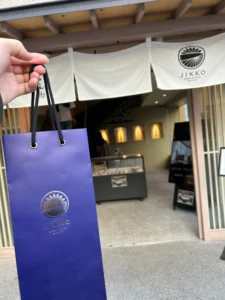
[cap_box title=”⚡ Quick Answer”]JIKKO (實光刃物) is a 120-year-old knife maker from Sakai, Japan. I purchased their Nakiri knife at the Tokyo Kappabashi store and have used it daily. Verdict: glides through vegetables with almost no pressure at all, exceptional craftsmanship, worth every yen for serious home cooks.[/cap_box]
IKKO (實光刃物) is a 120-year-old knife maker from Sakai, Japan. I purchased their Nakiri knife at the Tokyo Kappabashi store and have used it daily. Verdict: glides through vegetables with almost no pressure at all, exceptional craftsmanship, worth every yen for serious home cooks.
About JIKKO: 120 Years of Sakai Craftsmanship
JIKKO (實光刃物, Jikko Hamono) was founded in 1901 in Sakai, Osaka Prefecture — the city producing over 90% of Japan’s professional chef knives. Sakai’s knife-making tradition spans 600 years, originally supplying samurai blades before pivoting to kitchen cutlery during the Edo period.
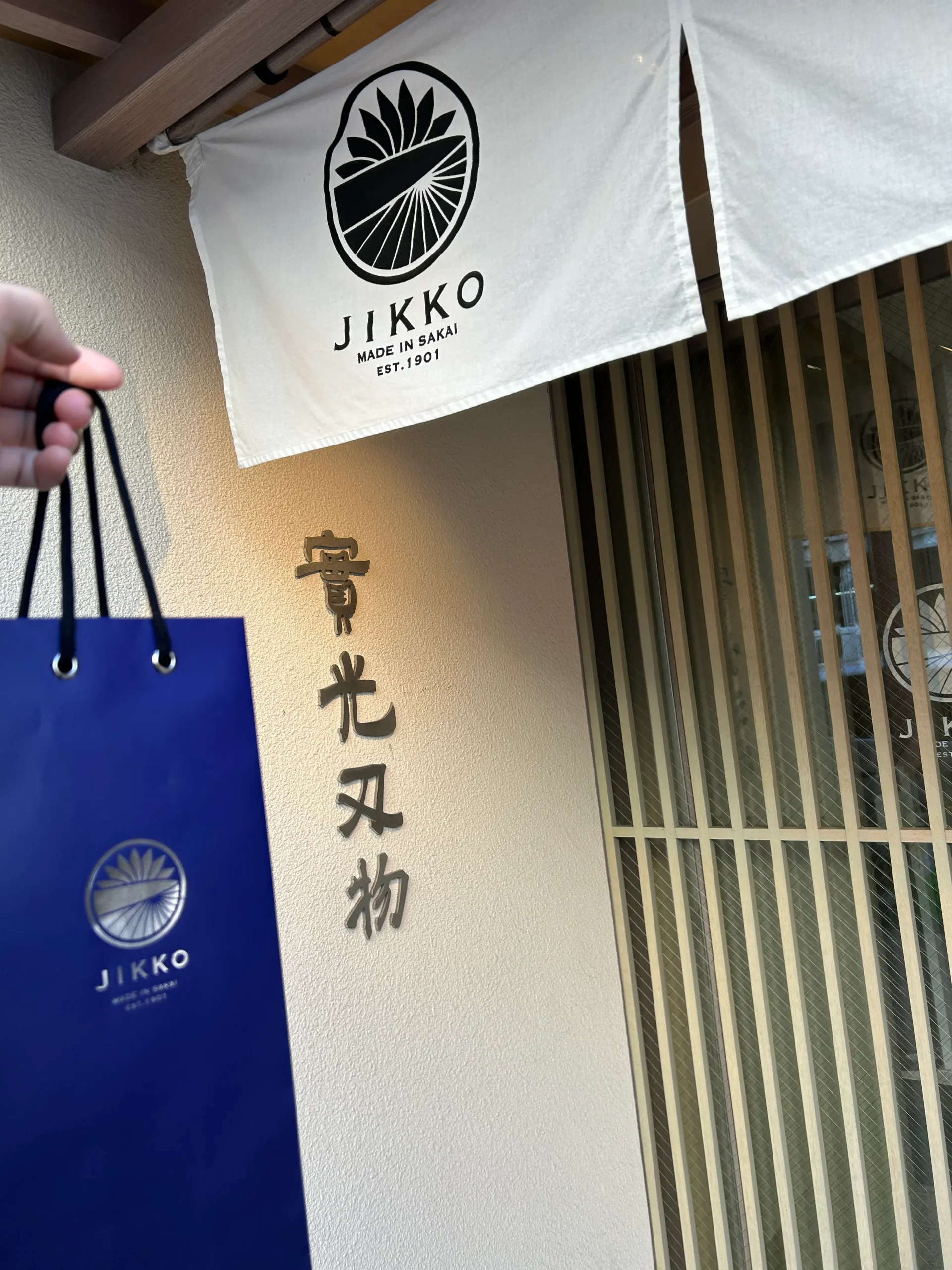
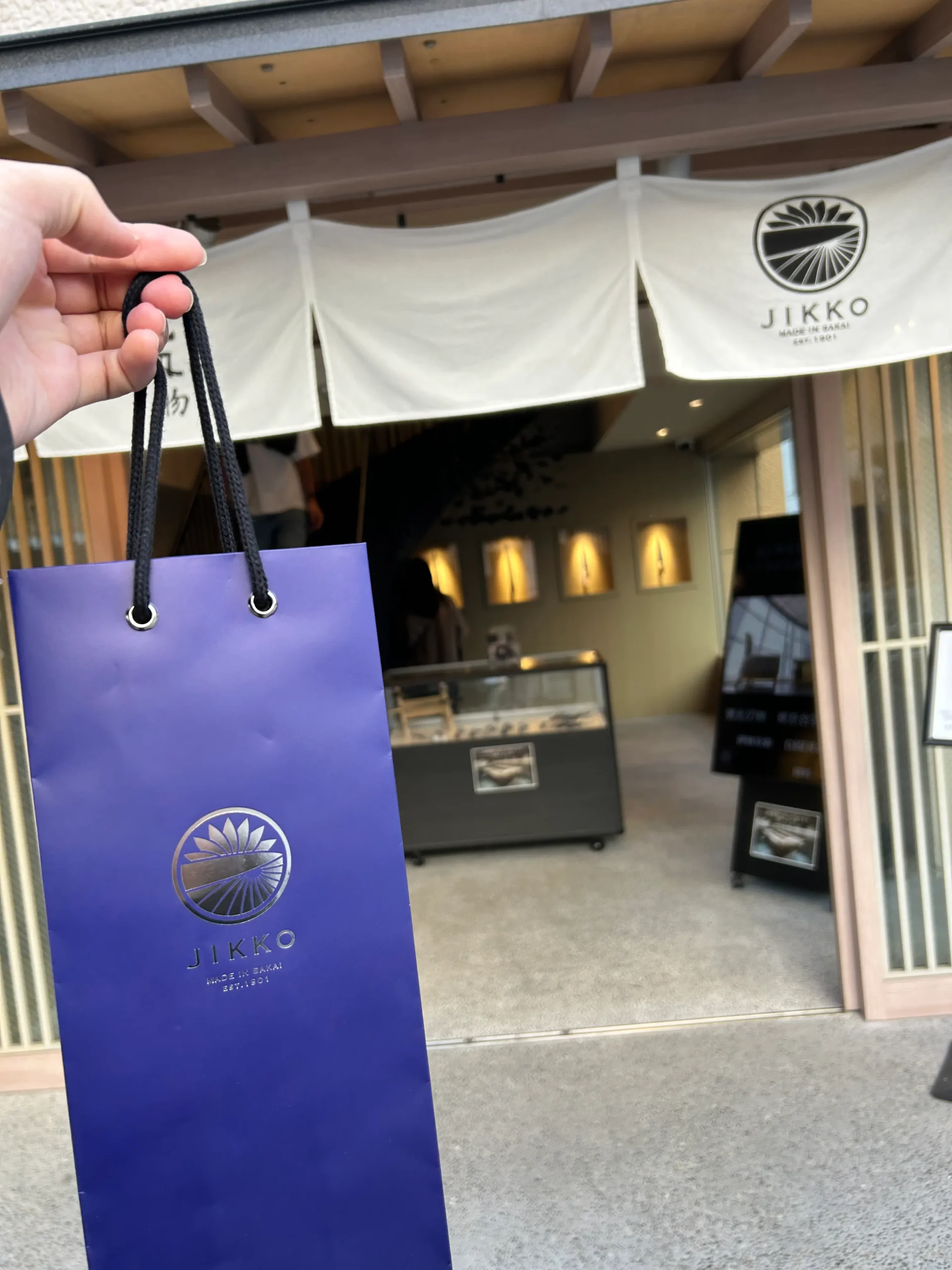
Every JIKKO knife is crafted in Sakai using traditional forging techniques refined over generations. I purchased mine at their Tokyo Kappabashi store (合羽橋 — Japan’s famous “Kitchen Town”), where knowledgeable staff guide you through each knife’s steel type and intended use — an experience no online retailer can replicate.
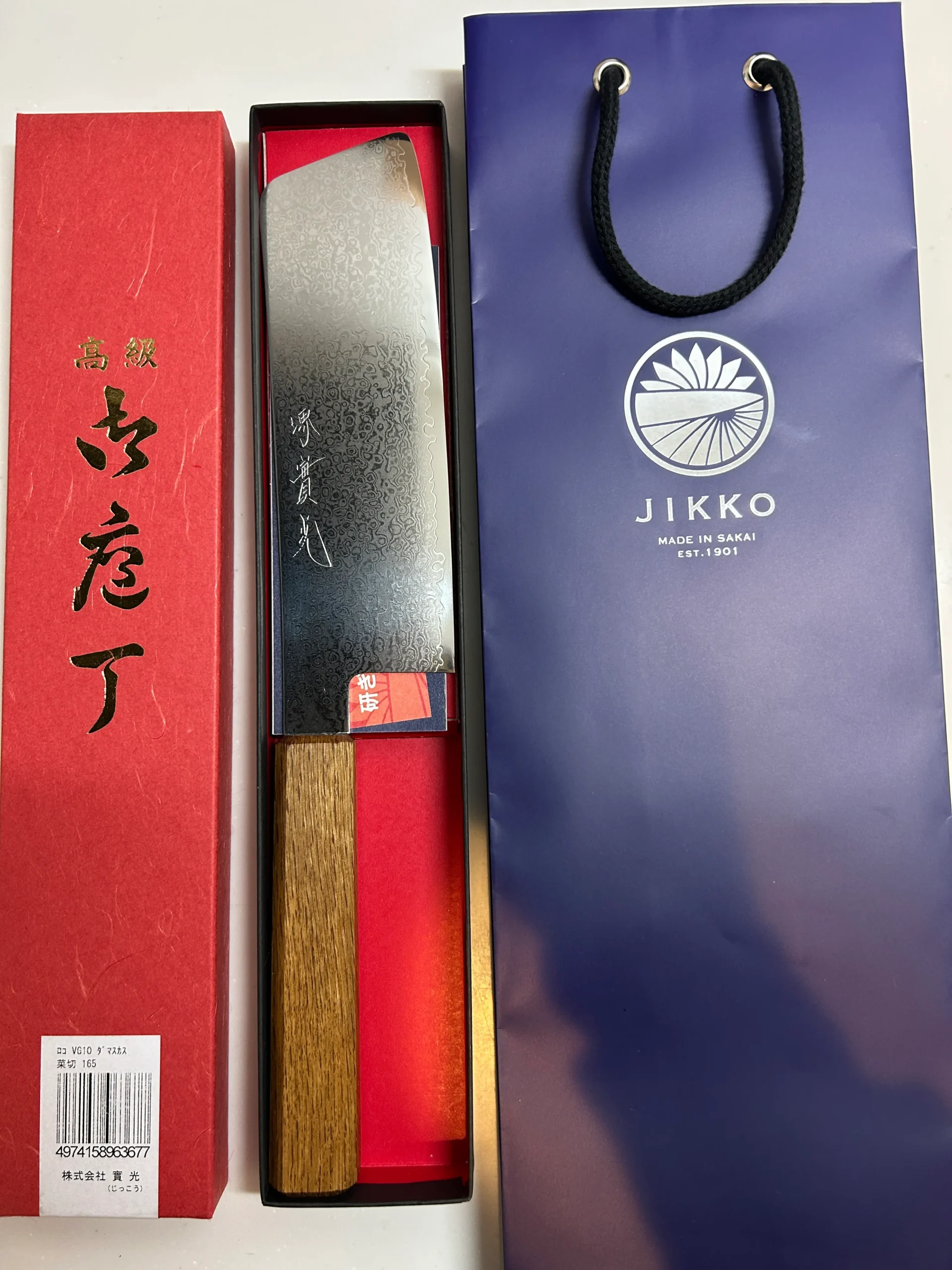
The Knife I Tested: JIKKO Nakiri (菜切り包丁)
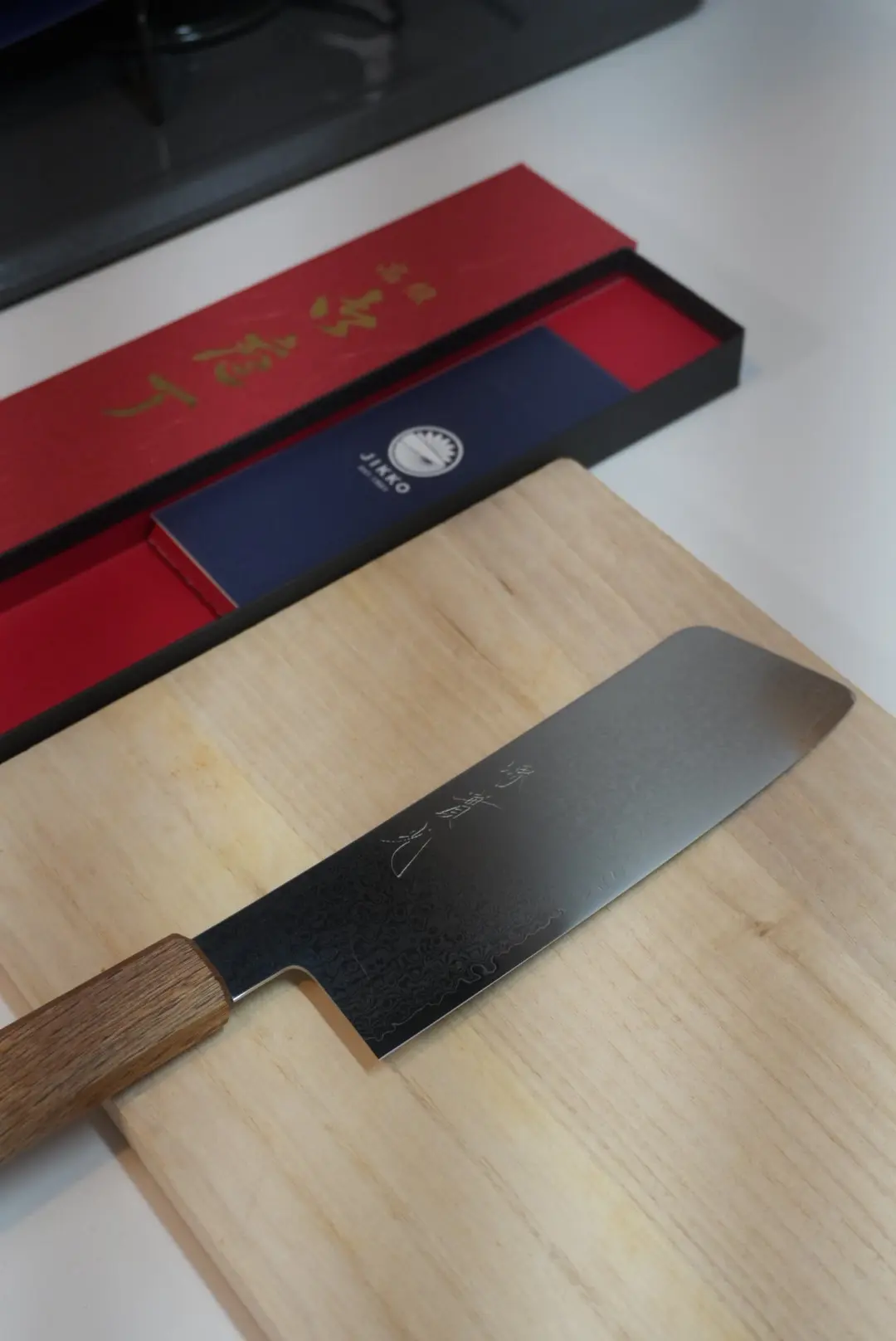
The knife I purchased is the JIKKO Nakiri (菜切り包丁) — a Japanese vegetable knife with a flat, rectangular blade designed for push-cutting: straight up-and-down chopping with no rocking motion. It excels at vegetables, herbs, and precise prep work.
Specifications
| Spec | Detail |
|---|---|
| Knife Type | Nakiri (菜切り — Japanese vegetable knife) |
| Brand | JIKKO (實光刃物), Est. 1901 |
| Origin | Sakai, Osaka, Japan |
| Blade Finish | Kurouchi-style Damascus texture with hand engraving |
| Bevel | Double-bevel (ryoba / 両刃) |
| Edge Angle | ~15 degrees per side |
| Handle | Octagonal natural wood (magnolia / oak) |
| Hardness | HRC 60–63 (high-carbon steel) |
| Packaging | Premium lacquered red gift box |
| Where to Buy | JIKKO store (Kappabashi Tokyo / Sakai) · Hocho Knife online |
First Impressions: Unboxing the JIKKO Nakiri
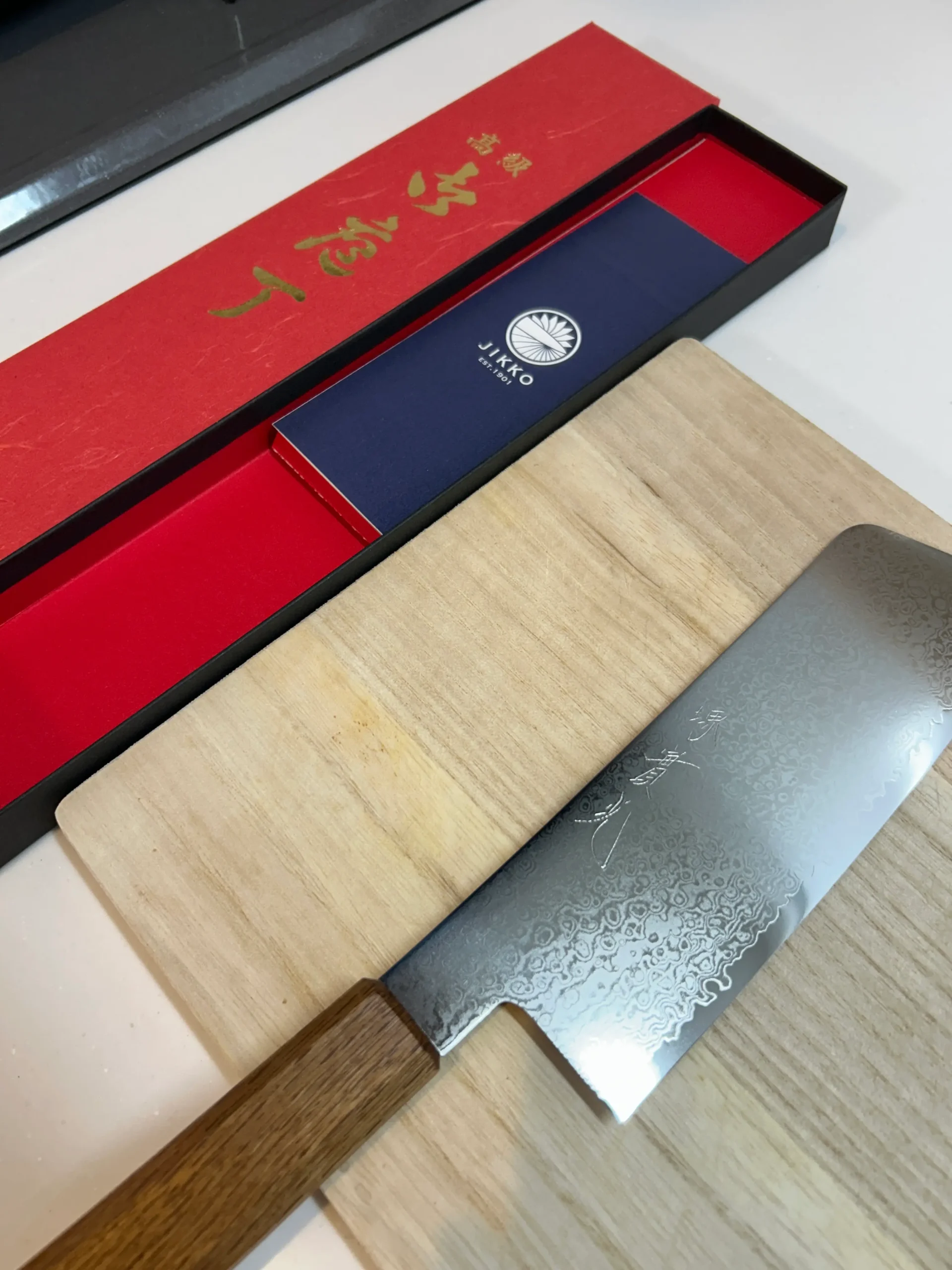
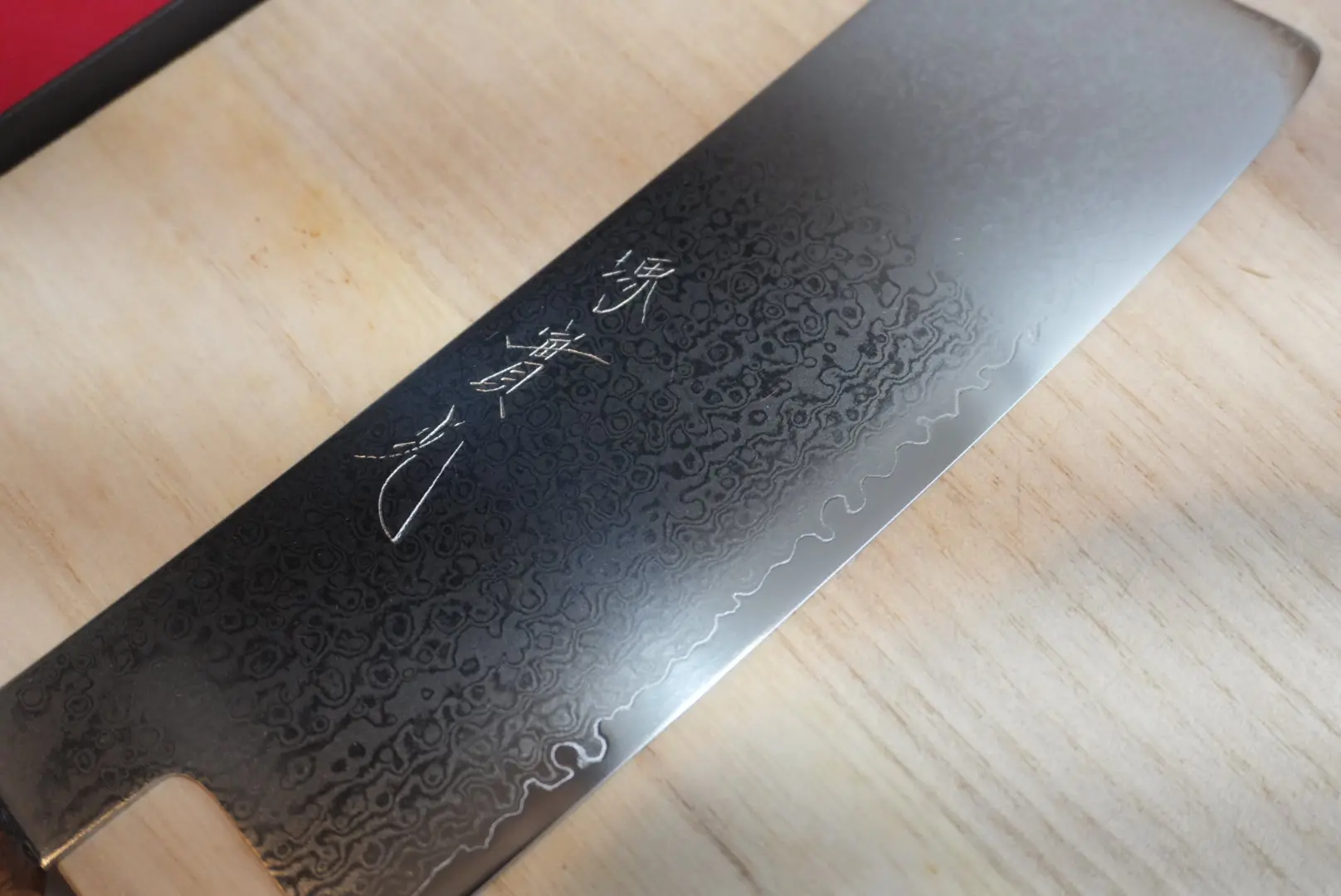
Opening the lacquered red gift box, the craftsmanship is immediately apparent. The blade’s kurouchi-style dark finish with its flowing Damascus-like texture is visually striking — this is clearly not a factory knife. Hand-engraved Japanese kanji runs along the blade face, a hallmark of Sakai craftsmanship impossible to replicate in mass production.
The octagonal wooden handle sits naturally in the hand. Japanese knife handles are deliberately lighter than German counterparts, shifting the balance toward the blade for more precise control. Out of the box, the knife passed the paper-slice test effortlessly — clean, straight cuts with zero drag.
Performance: How the JIKKO Nakiri Handles Real Vegetables
Sharpness and Edge Retention
The JIKKO Nakiri requires almost no pressure at all. In daily use — tomatoes, onions, cabbage, carrots — it simply glides through with a clean, effortless motion. You barely need to push. The flat blade makes full contact with the cutting board on each stroke, enabling cleaner, more consistent cuts than any German-style rocking knife I have used.
After several months of regular home use, the edge holds up exceptionally well. Japanese high-carbon steel at HRC 60–63 stays sharp significantly longer than softer Western steel (HRC 56–58), but is more brittle — avoid cutting frozen foods or bones.
Handle and Balance
The octagonal handle is comfortable for both pinch-grip and handle-grip users. It does not rotate in wet hands the way round handles can. The balance leans slightly blade-heavy, ideal for a Nakiri — letting gravity assist during straight-down vegetable cuts.
Maintenance
Like all quality Japanese knives, the JIKKO Nakiri requires hand-washing only — no dishwasher, ever. My personal routine: wash by hand within 10 minutes of use and dry immediately. That simple habit keeps the blade in excellent condition. The steel rewards proper care with long-term performance.
Pros and Cons
Pros
- Razor-sharp factory edge — ready immediately
- Beautiful hand-engraved Damascus-style blade
- 120 years of authentic Sakai craftsmanship
- Excellent edge retention (HRC 60–63)
- Premium gift-ready packaging
- Well-balanced for precise vegetable work
Cons
- Hand-wash only — no dishwasher
- More brittle than German steel
- Requires hand-washing and proper sharpening care
- Higher price than mass-market knives
- Nakiri push-cut style needs practice
- Limited availability outside Japan
Who Should Buy the JIKKO Nakiri?
Buy JIKKO if you are:
- A serious home cook wanting a genuine step up from supermarket knives
- A collector who values Japanese blade aesthetics and heritage
- Someone buying a premium gift — the packaging alone impresses
- A cook focused on vegetables, fish, or boneless proteins
- Someone willing to maintain their knife properly (hand-wash, dry, occasional sharpening)
Skip JIKKO if you are:
- Someone who uses the dishwasher for knives
- A cook regularly cutting through bones or frozen food
- On a tight budget — JIKKO is a deliberate investment
Where to Buy JIKKO Knives
- In Japan (Tokyo): JIKKO Kappabashi store (合羽橋) — best experience, staff guidance
- In Japan (Osaka): JIKKO Sakai showroom and production facility
- Online (International): Hocho Knife — Japan-based specialist shipping worldwide
- Online (US/Global): Amazon (limited selection — verify authenticity)
Frequently Asked Questions
Is JIKKO a good knife brand?
Yes. JIKKO (實光刃物) is one of Japan’s most respected knife makers, with 120+ years of production history in Sakai — the city producing over 90% of Japan’s professional chef knives. Their knives feature handcrafted high-carbon steel with traditional Sakai forging techniques absent from mass-market brands.
Where are JIKKO knives made?
JIKKO knives are made in Sakai, Osaka Prefecture, Japan. Sakai has been Japan’s knife-making capital for over 600 years. JIKKO was established there in 1901 and continues producing all knives at their Sakai facility.
What steel does JIKKO use?
JIKKO offers multiple steel options including high-carbon stainless steel and Blue Steel (Aogami) variants. Their knives typically reach HRC 60–63 — significantly harder than German knives (HRC 56–58), enabling a sharper and longer-lasting edge.
What is a Nakiri knife used for?
A Nakiri (菜切り包丁) is a Japanese vegetable knife with a flat, rectangular blade. It excels at push-cutting vegetables — straight chopping without rocking. Ideal for onions, cabbage, carrots, and herbs. Not designed for bones or frozen foods.
How do I sharpen a JIKKO knife?
A whetstone gives the best results — start with 1,000-grit to restore the edge, finish with 6,000-grit to polish. A quality knife sharpener also works fine for regular home use. Use a sharpener for day-to-day maintenance and a whetstone for a deeper edge refresh.
Can I buy JIKKO knives outside Japan?
Yes. While JIKKO physical stores are in Japan, their knives are available internationally through Hocho Knife — a Japan-based specialist shipping worldwide. This is the most reliable way to purchase authentic Sakai-made JIKKO knives outside Japan.
Our Verdict: Is the JIKKO Nakiri Worth It?
Is JIKKO worth it? Yes — if you are ready for it.
The JIKKO Nakiri is not a beginner’s knife, and it is not cheap. But for anyone who wants to experience what a hand-crafted Japanese knife from one of Sakai’s most storied makers feels like in their kitchen, JIKKO delivers completely. The sharpness is exceptional, the craftsmanship is visible in every detail, and buying in person at Kappabashi — with knowledgeable staff and no sales pressure — is an experience no online retailer can replicate.
I use mine daily. It has changed how I approach vegetable prep entirely.
“This knife makes me want to cook every single day. The way it glides through cabbage and bell peppers — that satisfying, clean crunch — is genuinely hard to describe. You just have to feel it.”
Overall Rating: 4.8 / 5
Sharpness: 5/5 | Craftsmanship: 5/5 | Value for Money: 4/5 | Ease of Maintenance: 3/5
Disclosure: Some links are affiliate links. If you purchase through them, we earn a small commission at no extra cost to you. We only recommend products we have personally tested.