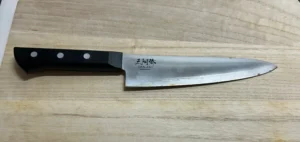
Choose the gyuto if you cook with meats, large proteins, and want a knife that handles both rocking cuts and long slicing strokes. Choose the santoku if you primarily prepare vegetables and fish at home, or prefer a shorter, lighter knife with a flatter cutting edge. Both are exceptional — the right answer depends entirely on how you cook.
What Is a Gyuto?
The gyuto (牛刀) emerged in Meiji-era Japan as Japanese bladesmiths adapted the Western chef’s knife to suit Japanese metallurgy and technique. The literal translation — “cow sword” — reflects its original role as a butcher’s knife for breaking down beef, an animal that became central to Japanese cuisine only after the 1868 Meiji Restoration lifted a centuries-old ban on meat eating.
Today, the gyuto is the workhorse of professional Japanese kitchens. At 210 to 270mm, it is the longest double-bevel knife a Japanese chef typically reaches for, and its swept tip, belly curve, and thin spine make it equally capable of rocking through herbs, slicing through a roast, and breaking down a whole fish.
What separates a Japanese gyuto from a German chef’s knife is geometry. A gyuto is ground to a much thinner edge — often 10–15° per side versus 20–25° on a Wüsthof or Henckels — and uses harder steel (typically 60–65 HRC) that holds an edge longer but requires more care. The result is a knife that feels effortless on the board.
Gyuto — Key Characteristics
| Length | 210–270mm (210mm most common) |
| Bevel | Double-edged (50/50 or 60/40) |
| Tip shape | Pointed, swept upward |
| Edge profile | Curved belly — suited to rocking cuts |
| Steel hardness | Typically 60–65 HRC |
| Edge angle | 10–15° per side |
| Best for | Meat, fish, all-purpose prep |
| Primary technique | Rocking cuts, long slicing strokes |
What Is a Santoku?
The santoku (三徳) was developed in Japan in the 1940s and 1950s as the country’s traditional nakiri (vegetable cleaver) was adapted for a broader range of ingredients. The “three virtues” — fish, meat, and vegetables — define its intended scope: a true all-purpose knife for the home cook.
Its most recognisable feature is the sheep’s foot tip: instead of sweeping upward to a point, the spine drops straight down to meet the edge. This creates a flat cutting edge ideal for up-and-down chopping strokes and precise push-cuts. The shorter length (165–190mm standard) makes the santoku easier to manoeuvre and less intimidating than a long gyuto — which is part of why it became Japan’s most popular home kitchen knife.
Many santoku knives feature granton (hollow ground) dimples along the blade, which reduce suction and help food release cleanly — especially useful with sticky vegetables like potatoes or cucumbers.
Santoku — Key Characteristics
| Length | 165–190mm (165mm most common) |
| Bevel | Double-edged (50/50 or asymmetric) |
| Tip shape | Sheep’s foot — spine drops to edge |
| Edge profile | Flat — minimal belly |
| Steel hardness | Typically 58–63 HRC |
| Edge angle | 10–15° per side |
| Best for | Vegetables, fish, everyday home cooking |
| Primary technique | Push-cuts, up-and-down chopping |
Gyuto vs Santoku: Head-to-Head
| Attribute | Gyuto | Santoku |
|---|---|---|
| Typical Length | 210–270mm | 165–190mm |
| Tip Shape | Pointed, swept up — better for detail work | Sheep’s foot (blunt drop) |
| Edge Profile | Curved belly — good for rocking | Flat — better for push-cuts & chopping |
| Weight | Moderate – heavier as length increases | Lighter — easier for long sessions |
| Meat & Proteins | Excellent — long blade slices cleanly | Good for smaller proteins |
| Vegetables | Very good | Excellent — flat profile chops cleanly |
| Fish | Excellent — long strokes fillet cleanly | Good for small to medium fish |
| Rocking Cuts | Natural — curved belly rolls smoothly | Limited by flat edge |
| Push-Cuts | Capable | Natural — flat edge lifts cleanly |
| Learning Curve | Moderate | Low — intuitive for beginners |
| Professional Use | Industry standard | Primarily home kitchens |
| Price Range | $80–$600+ | $60–$400+ |
Which Should You Choose?
The honest answer: most home cooks will be perfectly happy with either. But there are genuine reasons to lean one way or the other.
Choose the Gyuto if you…
- Cook large proteins regularly (whole chickens, roasts, fish fillets)
- Already know the rocking-cut technique from a Western chef’s knife
- Want one knife that does everything in a professional context
- Prefer longer reach and sweeping slicing strokes
- Are building a serious knife collection and want the cornerstone
Choose the Santoku if you…
- Focus on vegetables, tofu, and small proteins
- Prefer chopping and push-cuts over rocking
- Have a smaller kitchen or limited board space
- Are new to Japanese knives and want an approachable first buy
- Cook for one or two people and value agility over reach
Can you own both? Absolutely — and many cooks do. A 210mm gyuto for proteins and a 165mm santoku for daily vegetable prep is one of the most practical two-knife combinations in a home kitchen. They complement each other almost perfectly.
Best Gyuto Knives [2026]
These are the gyuto knives we recommend at each price point, chosen for consistent performance, reliable steel, and value for money.
#1 — Misono UX10 Gyuto (Editor’s Choice)
Price: $491.67 · High Carbon Stainless Steel · Black Reinforced Wood Handle · 8.3″ (210mm) · 5.0★ (5 reviews)
The Misono UX10 is the benchmark gyuto for serious home cooks and professionals who want Japanese precision without the upkeep of reactive carbon steel. Made from high-purity Swedish stainless steel hardened to 60 HRC, the blade holds a razor edge through heavy daily use while remaining far more forgiving than harder steels like SG2. At 210mm (8.3″) with a 2.1mm spine, it sits in the ideal sweet spot — long enough for confident pull-slicing on proteins, nimble enough for precise vegetable work. The black reinforced wood handle provides a secure, balanced grip at just 170g. Made in Seki, Japan.
Pros
- High-purity Swedish stainless — sharp and low-maintenance
- 60 HRC — durable edge without brittleness
- Balanced 170g weight — comfortable all-day use
- 2.1mm spine — thin enough for precision work
- Available in multiple lengths (180–330mm)
Cons
- Premium price — significant investment
- Not as thin-ground as harder SG2/carbon options
- Bolster-style handle may feel blocky to some
#2 — Tojiro DP Gyuto (Best Value)
Price: $122.00 · VG-10 Stainless Steel · Composite Wood Handle · 7.08″ (180mm) · 4.6★ (325 reviews) · Overall Pick
The Tojiro DP is consistently cited as the best-value entry point into Japanese gyuto knives — and the numbers back it up. The VG-10 core steel at 60 ±1 HRC delivers a razor edge that holds up through heavy daily prep, performing well above its price point. The double-edged (50/50) bevel makes it fully ambidextrous, and the stainless character means you can cook without worrying about reactive maintenance. At 7.08″ (180mm), it’s slightly shorter than a standard chef’s knife — more agile for everyday vegetable and protein work. The composite wood handle offers a secure, moisture-resistant grip. Made in Tsubame-Sanjo, Japan.
Pros
- VG-10 at 60 HRC — sharp edge at an accessible price
- Double-edged 50/50 bevel — works for all users
- Agile 180mm length — ideal for home kitchen prep
- Overall Pick · 4.6★ / 325 reviews
- Made in Tsubame-Sanjo, Japan
Cons
- 180mm may feel short for larger cutting tasks
- VG-10 can micro-chip if used on bones
- Finish is utilitarian compared to premium picks
#3 — Yoshimi Kato SG2 Gyuto (Best Premium)
Price: $230–$270 · SG2 (R2) Powder Steel · Handmade in Takefu, Japan · 210mm
Yoshimi Kato is one of the most respected bladesmiths working out of Takefu Village. The SG2 (also called R2) reaches 63–64 HRC — harder than VG-10, capable of a keener edge, and surprisingly resistant to corrosion. The nashiji (hammered) finish reduces food adhesion and gives each knife a subtly individual look. The wa-handle (octagonal magnolia with a buffalo horn collar) is traditional and exceptionally balanced.
Pros
- SG2 steel: exceptional edge retention
- Beautiful nashiji finish
- Traditional wa-handle with superb balance
- Handmade — individual character
Cons
- Hard steel requires diamond or ceramic stones to sharpen
- Wa-handle not suited to all grips
- Higher price point
Best Santoku Knives [2026]
These santoku picks cover every budget and cooking style, from the daily-driver stainless to the knife that will still be in your family in 30 years.
#4 — Global G-48 Santoku (Editor’s Choice)
Price: $149.95 · CROMOVA 18 Molybdenum/Vanadium Stainless · Hollow Ground · Stainless Steel Handle · 7″ (180mm) · 4.6★ (437 reviews) · Overall Pick
The Global G-48 has been the gateway Japanese knife for home cooks since the 1980s — and it still earns that reputation. The CROMOVA 18 molybdenum/vanadium stainless steel is face-ground with a long taper so the edge stays sharp longer and returns to a working edge quickly with a ceramic rod. The hollow ground indentations along the blade face reduce sticking when slicing soft vegetables and proteins. The seamless one-piece stainless construction — handle included — means no crevices, effortless cleaning, and a distinctively balanced feel. The dimpled handle is molded for comfort and secure grip, even with wet hands. Backed by a lifetime guarantee from Global. Hand wash only. Made in Niigata, Japan.
Pros
- Hollow ground blade — reduces food sticking
- Seamless one-piece steel — hygienic, no crevices
- Dimpled handle — secure grip even when wet
- Forgiving CROMOVA 18 steel — beginner-friendly
- Overall Pick · 4.6★ / 437 reviews · Lifetime guarantee
Cons
- Softer steel — won’t hold edge as long as VG-10 or SG2
- All-steel handle feel is polarising
- Hand wash only
#5 — MAC Professional Santoku (Best Value)
Price: $128.95 · Alloy Steel · Black Pakka Wood Handle · 6.5″ (165mm) · 4.6★ (356 reviews) · Amazon’s Choice · 50+ bought last month
The MAC Professional MSK-65 is a consistent favourite among home cooks who want a high-performing santoku without a premium price tag. What sets it apart is the sub-zero tempered alloy steel — a cryogenic hardening process that helps the edge retain sharpness significantly longer than conventionally treated steel. The 2.5mm blade is thin enough to glide through vegetables with minimal resistance, while the hollow (dimple) ground face reduces sticking on soft produce like potatoes and cucumbers. The black Pakka wood handle is comfortable and moisture-resistant. Hand wash recommended. Made in Japan.
Pros
- Sub-zero tempered steel — edge stays sharp longer
- 2.5mm thin blade — low-resistance cutting
- Hollow ground dimples — reduces food sticking
- Amazon’s Choice · 4.6★ / 356 reviews
- Made in Japan
Cons
- 6.5″ may feel short for larger prep tasks
- Understated aesthetics — no Damascus pattern
- Hand wash only — not dishwasher safe
#6 — Shun Classic Santoku (Best Gift)
Price: $139.99 · High-Carbon Stainless Steel · 16-Layer Damascus Cladding · D-shaped Pakkawood Handle · 7″ (178mm) · 4.7★ (1,473 reviews)
The Shun Classic DM0702 is one of the most gifted Japanese knives in the US market — and it earns that reputation. The precision-forged high-carbon stainless steel blade holds a razor-sharp edge through regular home cooking, while the 16-layer Damascus cladding produces a stunning rust-free pattern that makes it as much a showpiece as a working tool. The D-shaped Pakkawood handle with offset steel bolster fits naturally in the hand, and Shun backs every knife with free lifetime sharpening and honing. Available in black Pakkawood ($139.99) or blonde Pakkawood ($154.95). Handcrafted in Seki City, Japan.
Pros
- High-carbon stainless — razor-sharp, rust-resistant
- 16-layer Damascus — stunning pattern at this price
- D-shaped Pakkawood — comfortable ergonomic grip
- Free lifetime sharpening from Shun
- 4.7★ / 1,473 reviews — proven track record
Cons
- Damascus finish scratches if stored carelessly
- Hard steel — avoid bones and frozen food
- Hand wash only
Frequently Asked Questions
- Is a gyuto harder to use than a santoku?
-
Not significantly — both are double-bevel knives with similar edge angles. The gyuto’s longer blade requires slightly more wrist awareness on a small board, and the pointed tip demands more care around fingers. The santoku’s shorter length and flat edge do make it marginally more intuitive for beginners, but “difficult” would be an overstatement for either knife.
- Can I use a santoku instead of a chef’s knife?
-
Yes — the santoku was designed to replace the Western chef’s knife in Japanese home kitchens. It handles the same core tasks: chopping vegetables, slicing proteins, mincing herbs. The main limitation is length: a 165mm santoku will feel short when slicing a large roast, where a 240mm gyuto gives you more reach. For everyday home cooking, the santoku is a complete solution.
- What is the difference between a gyuto and a nakiri?
-
The nakiri is a purpose-built vegetable knife — thin, rectangular, with a completely flat double-bevel edge and no pointed tip. It excels at push-cuts and precise julienne but is not suited to proteins or fish. The gyuto is a general-purpose knife that handles vegetables well but is designed with proteins in mind. Think of the nakiri as a specialist and the gyuto as a generalist.
- Do professional chefs use santoku knives?
-
Some do, but the gyuto is overwhelmingly the professional standard in Japanese restaurant kitchens. The santoku was developed for the home market — its shorter length and flat profile are less efficient for high-volume, varied prep work. That said, some chefs focused on vegetable-forward Japanese cuisine keep a santoku on their roll for specific tasks where its flat edge provides an advantage.
- Can I sharpen a gyuto or santoku at home?
-
Yes — and you should. Both are sharpened on whetstones at a consistent angle: typically 10–15° per side. A 1000/6000 combination stone is sufficient for maintenance sharpening. The same technique works for both knife types. Regular maintenance on a ceramic honing rod between sharpenings will extend the time between full stone sessions significantly.
- Which is better for cutting fish — gyuto or santoku?
-
For most fish prep at home, either works well. The gyuto’s longer blade and pointed tip give it an advantage for filleting: the tip can enter the fish precisely along the spine, and the longer edge allows clean, single-stroke cuts through the flesh. For slicing sashimi from a pre-filleted piece, a dedicated sashimi knife (yanagiba or sujihiki) is the specialist tool.
Final Verdict
The gyuto and the santoku both solve the problem of needing a single knife that handles most kitchen tasks. They just solve it differently. The gyuto solves it the way a professional chef would: longer, more versatile, comfortable with every technique from a rocking mince to a long sweeping slice. The santoku solves it the way a home cook in a compact Japanese kitchen would: shorter, lighter, optimised for the vegetables and proteins that make up most everyday meals.
If you cook proteins regularly and want one knife for everything, buy the gyuto first. If you mostly cook vegetables and Japanese-style food, or if you want a shorter, lighter option that’s less demanding of counter space and board size, start with the santoku. And if you eventually own both — you will understand why so many serious home cooks do.
This article contains affiliate links. If you purchase through our links, we may earn a small commission at no extra cost to you.