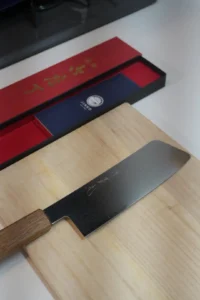
Nakiri Knife (菜切り包丁) is a Japanese vegetable knife with a rectangular, flat-edged blade. Unlike Western chef knives that rock on a curved belly, the nakiri’s straight edge makes full contact with the cutting board on every stroke — delivering clean, uniform cuts with zero compression. It’s the standard vegetable knife in Japanese home kitchens, and one of the most impactful upgrades for any cook who works with vegetables daily.
What Is a Nakiri Knife?
The word nakiri (菜切り) translates directly to “vegetable cutter” — 菜 (na) meaning greens or vegetables, 切り (kiri) meaning to cut. The name is a literal description of the knife’s purpose.
Originating in the Osaka region during the Edo period (17th century), the nakiri became the standard vegetable knife in Japanese home kitchens. While professional chefs gravitated toward the single-bevel usuba for extreme precision, home cooks embraced the nakiri’s double-bevel edge for its accessibility and ease of maintenance.
The defining feature is the flat, rectangular blade. There’s no curved belly like a Western chef knife — just a straight edge that lands flush on the cutting board from heel to tip. This geometry enables push-cuts (straight down and forward) rather than the rocking motion most home cooks are used to, producing cleaner, more uniform slices through any vegetable.
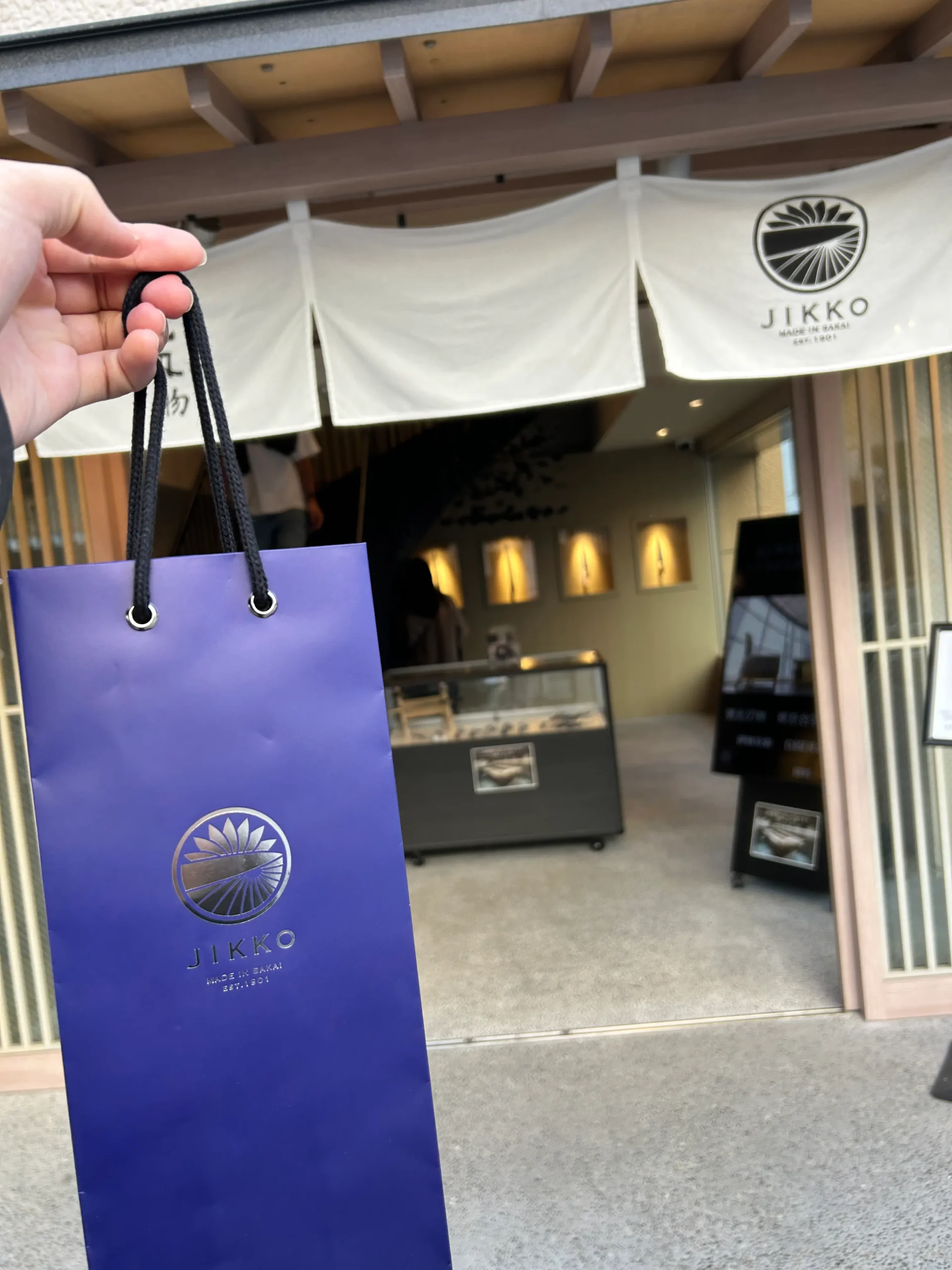
I first used a nakiri at Kappabashi — Tokyo’s famous knife district — after struggling with onion layers and carrot coins on my chef knife. The difference was immediate: no compression, no wedging, just clean cuts. I bought one on the spot and haven’t gone back.
- Blade shape: Rectangular, flat-tipped (top and bottom edge nearly parallel)
- Edge type: Double bevel — sharpened symmetrically on both sides
- Typical length: 165mm – 180mm
- Best for: All vegetables — slicing, dicing, julienning, chiffonade, brunoise
- Skill level: Beginner to advanced
- Origin: Osaka / Sakai region, Japan
Nakiri vs Other Japanese Knives
The nakiri isn’t the only Japanese knife used for vegetables. Here’s how it compares to the three alternatives you’ll most often encounter:
| Feature | Nakiri | Usuba | Santoku | Chef’s Knife |
|---|---|---|---|---|
| Edge Type | Double bevel | Single bevel | Double bevel | Double bevel |
| Blade Shape | Rectangular, flat | Rectangular, flat | Slightly curved tip | Curved belly |
| Cutting Motion | Push cut | Push cut | Push or rock | Rocking |
| Skill Level | Beginner–Advanced | Advanced / Pro | Beginner–Advanced | All levels |
| Vegetable Performance | ⭐⭐⭐⭐⭐ | ⭐⭐⭐⭐⭐ | ⭐⭐⭐⭐ | ⭐⭐⭐ |
| Meat / Fish | Limited | Limited | Yes | Yes |
| Typical Length | 165–180mm | 180–240mm | 165–180mm | 200–250mm |
| Price Range | $60–$300+ | $80–$500+ | $50–$400+ | $30–$400+ |
The Usuba: The Professional’s Nakiri
The usuba (薄刃包丁) looks similar to the nakiri but differs in one critical way: the single-bevel edge. Sharpened only on one side, it produces paper-thin slices and enables katsuramuki — the Japanese technique of peeling a vegetable into a continuous paper-thin sheet. Beautiful, but demanding. Unless you’re training in Japanese cuisine, start with a nakiri.
The Santoku: If You Want One Knife for Everything
The santoku (三徳 — “three virtues”) handles meat, fish, and vegetables. Its relatively flat edge profile makes it excellent for vegetable prep, but it’s a compromise. If vegetables are your primary focus, the nakiri’s dedicated geometry will serve you better. If you want one knife that does it all, the santoku wins.
Top 5 Nakiri Knives [2026]
After testing and researching extensively — including hands-on time at Kappabashi and sourcing through Japanese specialty retailers — here are the five nakiri knives worth your money in 2026.
#1 — JIKKO Damascus Nakiri (Editor’s Pick)
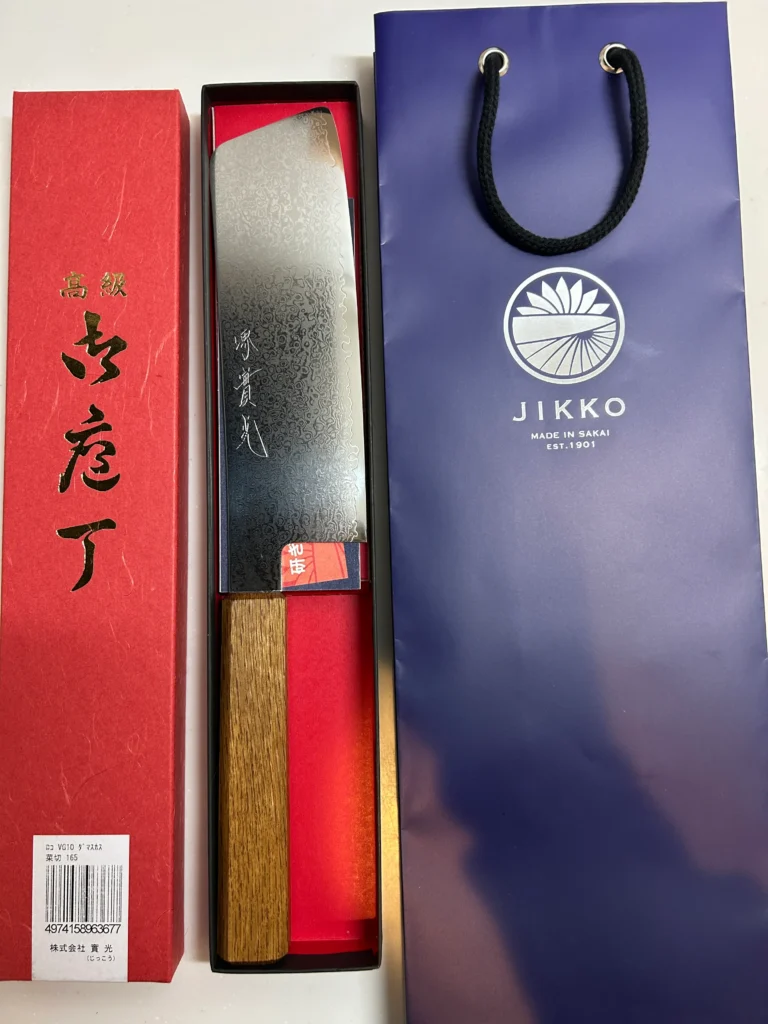
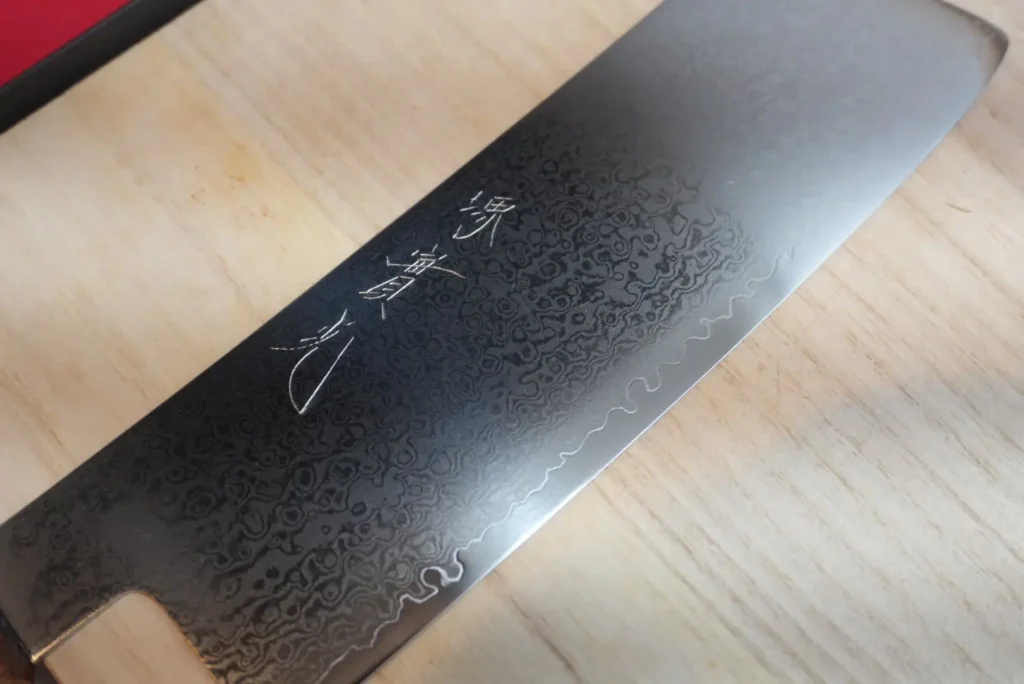
Price: $180–$220 · Made in Sakai, Japan · VG-10 Core · 33-Layer Damascus
The JIKKO Damascus Nakiri is the knife I reach for every time I cook. Made in Sakai — Japan’s knife-making capital — by JIKKO Cutlery, a fourth-generation workshop, this nakiri combines artisan craftsmanship with everyday usability. The VG-10 core steel hits the sweet spot between edge retention and ease of sharpening, and the 33-layer Damascus cladding isn’t just beautiful — it adds stiffness to the blade. The octagonal walnut handle sits naturally in either grip style. Nothing at this price point comes close for pure vegetable work.
Pros
- Sakai-made, fourth-generation artisan workshop
- VG-10 core — sharp, durable, easy to maintain
- 33-layer Damascus — beauty and function combined
- Octagonal walnut handle — comfortable for long sessions
Cons
- Premium price — investment piece
- Not dishwasher safe (hand wash only)
- Reactive to acidic foods without proper care
#2 — Sakai Takayuki Nakiri (Best Value)
Price: $169.99 · Made in Sakai, Japan · VG-10 Core · 33-Layer Hammered Damascus · 160mm
Also made in Sakai, the Sakai Takayuki delivers genuine Japanese craftsmanship at an entry-level price. The AUS-8 stainless steel won’t match VG-10 for edge retention, but it’s easy to sharpen and virtually maintenance-free. A great first nakiri that won’t feel like a compromise.
Pros
- VG-10 core — sharp, durable, easy to maintain
- 33-layer hammered Damascus — beautiful and reduces food sticking
- Hand-forged in Sakai — authentic Japanese craftsmanship
- Compact 160mm — agile and easy to control
Cons
- AUS-8 doesn’t hold an edge as long as VG-10
- Less refined fit and finish than premium picks
#3 — Shun Classic Blonde Nakiri (Best Premium Brand)
Price: $189.95 · Made in Seki, Japan · VG-MAX Core · 68-Layer Damascus · 6.5″ (165mm) · 4.8★ (1,055 reviews)
The Shun Classic Blonde Nakiri is one of the most acclaimed Japanese vegetable knives available in the US market — 4.8 stars across over 1,000 reviews. The VG-MAX core with 68 layers of Damascus cladding delivers razor-sharp precision at a 16-degree edge, and the edge retention is noticeably superior to standard VG-10. What sets the Blonde model apart is the natural blonde Pakkawood handle: D-shaped for a secure, comfortable grip, and designed for both left and right-handed users. Every knife is handcrafted in Japan with Shun’s legacy craftsmanship, and the brand backs it with free lifetime sharpening and honing. A genuine premium buy for the home cook ready to invest in quality.
Pros
- VG-MAX core + 68-layer Damascus — razor-sharp, long-lasting edge
- 16° edge angle — finer than most Japanese knives
- Works for both left and right-handed users
- Free lifetime sharpening & honing from Shun
- 4.8★ across 1,000+ Amazon reviews
Cons
- Premium price — significant investment for home use
- Made in Seki, not Sakai
- Hard steel requires care to avoid chipping on hard foods
#4 — Tojiro DP Nakiri (Best Budget)
Price: $114.62 · Made in Japan · Cobalt Alloy Steel Core · 13 Chrome Stainless Cladding · 165mm · 4.8★ (356 reviews)
The Tojiro Fujitora DP (FU-502) is built around a cobalt alloy steel core clad in 13 Chrome stainless steel — a combination that delivers genuine sharpness and durability well above its price point. The thin blade design is the standout feature: it glides through vegetables with noticeably less resistance than thicker-ground knives, and the flat nakiri profile keeps full edge contact on every stroke. The Western-style laminated reinforced handle is practical and secure, with the classic three-rivet construction familiar to most home cooks. Made in Japan, 4.8 stars across 356 reviews — consistently one of the best-rated nakiri knives available online.
Pros
- Cobalt alloy steel core — sharp, long-lasting edge
- Thin blade design — minimal resistance through vegetables
- Western three-rivet handle — familiar and secure grip
- Made in Japan · 4.8★ / 356 reviews
Cons
- Utilitarian aesthetics — no Damascus or decorative finish
- Heavier than wa-handle alternatives
- Hand-wash only
#5 — Miyabi Birchwood Nakiri (Best Luxury)
Price: $334.95 · Made in Seki, Japan · SG2 Powder Steel · 100-Layer Flower Damascus · Karelian Birchwood Handle · 6.5″ (165mm) · 4.7★ (240 reviews)
The Miyabi Birchwood SG2 is in a category of its own. The SG2 powder steel core reaches an extraordinary level of hardness, producing an edge that stays sharper longer than virtually anything else on this list — and the 100-layer flower Damascus pattern is structural, not decorative: it won’t wash, wear, or scratch off with normal use. The Karelian Birchwood handle is genuinely one of the most striking knife handles available at any price — each piece unique, lightweight, and warm in the hand. Chip and break resistance are built into the SG2 construction, making this a knife you buy once. At $334.95, it’s a deliberate luxury purchase — but for a gift or a long-term investment piece, nothing on this list comes close.
Pros
- SG2 powder steel — elite sharpness and edge retention
- 100-layer flower Damascus — structural pattern, won’t fade or scratch
- Karelian Birchwood handle — unique, lightweight, stunning
- Break and chip resistance built into SG2 construction
- Handcrafted in Seki, Japan · 4.7★ / 240 reviews
Cons
- $334.95 — significant investment for home use
- SG2 requires diamond or ceramic stones to sharpen
- Karelian Birchwood handle needs careful drying after use
How to Use a Nakiri Knife
The nakiri uses a slightly different cutting technique than a standard chef knife. Here’s how to get the most out of it:
- Use Push Cuts, Not Rocking — Push the blade forward and down in a single stroke. The nakiri’s flat edge is not designed for rocking; it will wear the edge unevenly over time and defeat the purpose of the flat geometry.
- Let the Full Edge Contact the Board — Keep your wrist level so the entire edge — heel to tip — lands flush on the cutting board simultaneously. You’ll immediately notice how much cleaner the cut is compared to a curved blade that leaves gaps.
- Use the Flat Side to Scoop and Transfer — After dicing, use the wide rectangular face to scoop everything off the board at once. The nakiri is essentially a small bench scraper with a razor-sharp edge.
- Grip with the Bear Claw — Curl your fingertips inward so your knuckles guide the blade. The nakiri’s flat spine glides against your knuckles, giving you complete control of slice thickness.
- Cut Straight Down on Dense Vegetables — For hard vegetables like carrots, burdock root, or winter squash, use a straight-down chopping motion with your guide hand pressing firmly on the vegetable. Avoid twisting or prying — it’s not a cleaver.
Nakiri Knife Buying Guide
Not all nakiri knives are equal. Here’s what to evaluate before buying:
Blade Length: 165mm vs 180mm
165mm is the standard for home kitchens — agile, easy to control, works in small spaces. Most common size and the one we recommend for most cooks. 180mm is preferred by taller cooks or those processing large volumes. Slightly more reach and a longer usable edge, but requires a larger cutting board.
Steel Type
VG-10 is the best all-rounder — sharp, rust-resistant, easy to maintain. The standard for quality Japanese knives. SG2 / R2 is premium powder steel: sharper and longer-lasting than VG-10, but harder to sharpen and more brittle. For experienced users. White Steel / Blue Steel are traditional Japanese carbon steels — exceptional sharpness but require oiling to prevent rust.
| Steel | Sharpness | Edge Retention | Rust Resistance | Maintenance |
|---|---|---|---|---|
| VG-10 | ⭐⭐⭐⭐ | ⭐⭐⭐⭐ | ⭐⭐⭐⭐⭐ | Easy |
| SG2 / R2 | ⭐⭐⭐⭐⭐ | ⭐⭐⭐⭐⭐ | ⭐⭐⭐⭐ | Moderate |
| White Steel | ⭐⭐⭐⭐⭐ | ⭐⭐⭐ | ⭐⭐ | High |
| Blue Steel | ⭐⭐⭐⭐⭐ | ⭐⭐⭐⭐ | ⭐⭐ | High |
Handle Style: Wa vs Yo
Wa-handle (和柄) — Traditional Japanese octagonal or oval wood handle. Lighter, more balanced toward the blade, preferred by experienced cooks who want full blade control. Yo-handle (洋柄) — Western-style bolster with riveted scales. Heavier handle, familiar feel for those new to Japanese knives.
Budget Guide
- Under $120: Tojiro DP (FU-502) — cobalt alloy steel, thin blade, made in Japan
- ~$170: Sakai Takayuki Hammered Damascus — VG-10 core, Sakai-made, hammered finish
- ~$190: Shun Classic Blonde — VG-MAX + 68-layer Damascus, 16° edge, free lifetime sharpening
- $180–$250: JIKKO Damascus — artisan-made, Sakai origin, best value at this tier
- $335: Miyabi Birchwood SG2 — luxury / gift tier, Karelian Birch handle
Frequently Asked Questions
- What does nakiri mean in Japanese?
-
Nakiri (菜切り) translates to “vegetable cutter.” 菜 (na) means greens or vegetables, and 切り (kiri) comes from the verb 切る (kiru), meaning to cut. The name is a literal description of the knife’s purpose.
- Is a nakiri knife worth buying?
-
Yes — if you cook vegetables regularly. The flat edge eliminates the compression and wedging that curved blades create, producing cleaner cuts and preserving vegetable texture. It’s one of the highest-impact knife upgrades for home cooks who eat plant-heavy diets.
- What is the best nakiri knife for beginners?
-
The Tojiro DP Nakiri ($114.62) is the most honest beginner recommendation — cobalt alloy steel, thin blade, made in Japan. If your budget allows, the JIKKO Damascus Nakiri is the pick we’d choose ourselves: Sakai-made, artisan quality, and built to last.
- Can you use a nakiri knife for meat?
-
Technically yes, but it’s not ideal. The nakiri’s thin blade is not designed for boning, breaking down joints, or heavy protein prep. Use it for vegetables and reach for a gyuto or chef knife for meat.
- What is the difference between a nakiri and usuba knife?
-
Both are Japanese rectangular vegetable knives with flat edges, but the key difference is the edge bevel. The nakiri is double-bevel (easy to use and maintain). The usuba is single-bevel (razor precision for professionals). Nakiri for home cooks; usuba for professionals.
- How do I sharpen a nakiri knife?
-
Use a whetstone (水砥石). Start with a 1,000-grit stone to restore the edge, then finish with a 3,000–6,000 grit stone for polish. Hold the blade at a consistent 15–17° angle on each side. Sharpen both sides equally. Avoid pull-through sharpeners — they remove too much material and damage the thin Japanese edge geometry.
Our Verdict
A nakiri knife is the most impactful upgrade you can make if you cook vegetables regularly. The flat edge, the precision, the way it glides through onion layers without compression — nothing else in your knife collection comes close. Once you cut with a good nakiri, going back to a rocking chef knife for vegetable prep feels like a step backward.
Our top pick is the JIKKO Damascus Nakiri — Sakai-made, VG-10 core, and built by a workshop that has been making knives for four generations. If you’re working with a tighter budget, start with the Tojiro DP and upgrade when you’re ready. Either way, your vegetable prep will never be the same.
This article contains affiliate links. If you purchase through our links, we may earn a small commission at no extra cost to you.