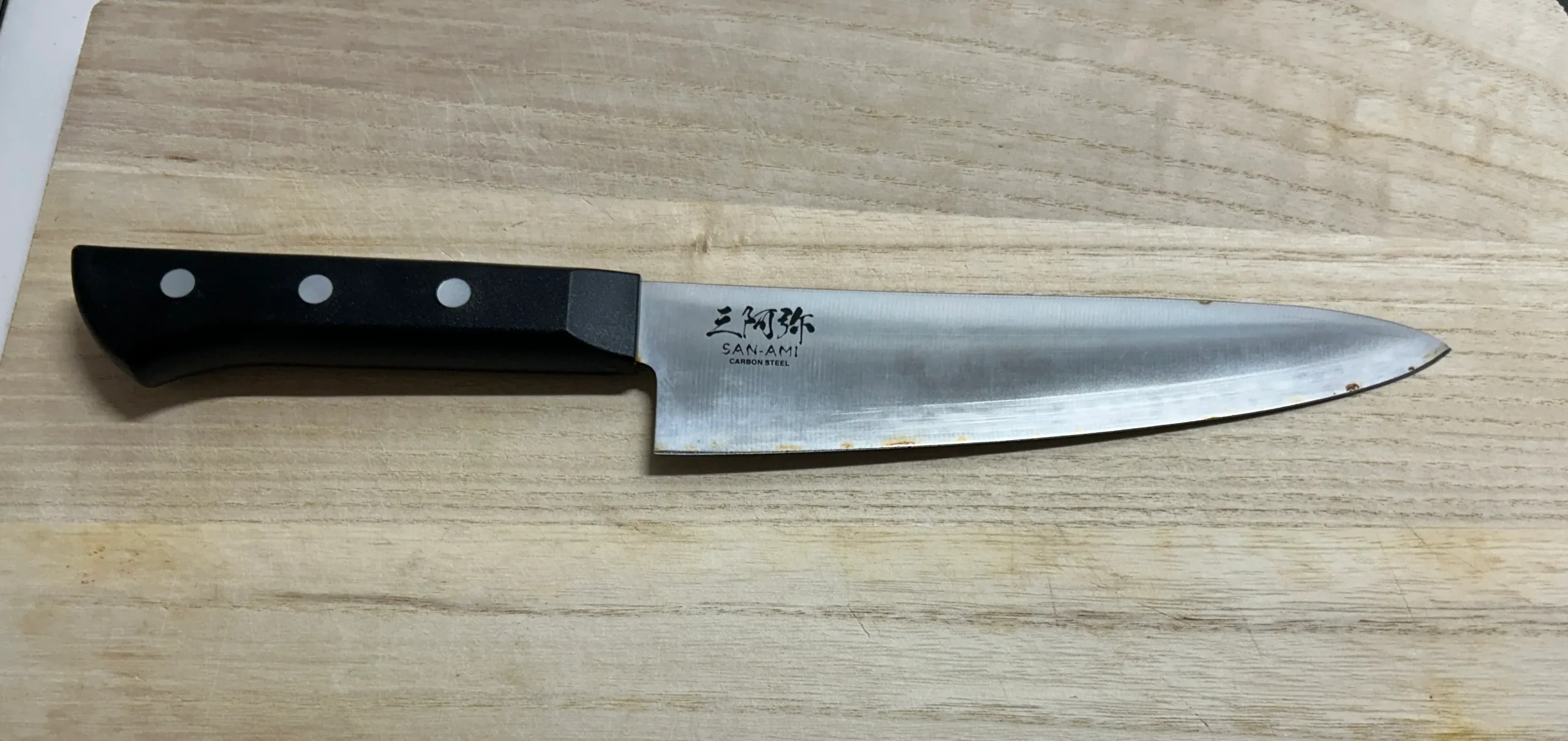
A santoku knife is a Japanese all-purpose kitchen knife used for slicing, dicing, and mincing vegetables, boneless meats, and fish. Its flat edge and shorter 5–7″ blade make it exceptionally maneuverable for everyday prep — the name literally means “three virtues,” referring to its three core tasks.
What Is a Santoku Knife?
The santoku (三徳包丁) is Japan’s most popular home kitchen knife. Developed in the mid-20th century as a Western-style adaptation of the traditional Japanese nakiri, it combines a vegetable-friendly flat edge with enough belly to handle meat and fish. The name encodes its purpose: san (three) + toku (virtues) — vegetables, meat, and fish.
Unlike a Western chef’s knife, the santoku’s blade is shorter (typically 165–180mm / 6.5–7″), wider at the spine, and nearly flat along the cutting edge. This geometry rewards a clean up-and-down chopping motion rather than a rocking technique — making it particularly intuitive for beginners while remaining a favourite among seasoned home cooks.
Key Characteristics
| Blade Length | 160–180mm (6.3–7″) |
| Edge Type | Flat / slight curve |
| Bevel | Double-bevel (most), 15–17° |
| Tip Profile | Sheep’s foot (blunt drop tip) |
| Steel | Stainless or high-carbon |
| Origin | Japan |
The 6 Best Uses for a Santoku Knife
The santoku’s wide, flat blade and manageable length make it remarkably versatile. Here are the six tasks where it genuinely excels:
- Chopping Vegetables — The flat edge maintains full contact with the board, making clean push-cuts through root vegetables, cabbage, and onions effortless.
- Mincing Herbs — The wide blade lets you gather and re-chop herbs quickly. Garlic, parsley, and ginger are reduced to fine mince without bruising.
- Slicing Fish — A sharp santoku glides through salmon, tuna, and other boneless fish fillets with precision. The flat spine helps maintain consistent thickness.
- Cutting Boneless Meat — Chicken breasts, pork loin, and thin beef cuts are no problem. The santoku handles everyday protein prep cleanly — avoid bone-in cuts.
- Slicing Cheese — The wide flat blade doubles as a scoop, and semi-hard cheeses are cut cleanly. Look for Granton-edge versions to minimize sticking.
- Precision Fruit Work — Hulling strawberries, segmenting citrus, or dicing mango — the shorter, controlled blade length makes detailed fruit prep comfortable and safe.
What a Santoku Is Not For: Despite its versatility, avoid using it on bone-in poultry, crusty bread, frozen foods, or heavy butchering tasks. The thin blade geometry is optimised for precision, not leverage or impact.
Santoku vs Chef’s Knife: Key Differences
The santoku and Western chef’s knife are the two most popular all-purpose knives in the world — but they’re designed around different cooking styles and cutting techniques.
| Feature | Santoku | Chef’s Knife |
|---|---|---|
| Blade Length | 160–180mm (6.3–7″) | 200–250mm (8–10″) |
| Blade Shape | Wide, flat edge, sheep’s foot tip | Curved edge, pointed tip |
| Cutting Motion | Push-cut / up-down chop | Rock chop / draw slice |
| Weight | Lighter (120–170g) | Heavier (200–280g) |
| Edge Angle | 15–17° (sharper) | 20–22° (more robust) |
| Best For | Veg, fish, precise work | Large veg, meat, bulk prep |
| Learning Curve | Low — intuitive chop | Moderate — rocking technique |
| Price Range | $40–$300+ | $30–$400+ |
If you predominantly cook Asian-inspired meals with lots of vegetables, the santoku’s flat edge and lighter weight will feel more natural. If you frequently break down large roasts or need maximum versatility for Western cooking, an 8″ chef’s knife may serve you better. Many cooks own both — they complement each other perfectly.
Top Santoku Knife Picks for 2026
These three santoku knives represent the best options across different budgets — each evaluated against real cooking performance.
#1 — Shun Classic 7″ Santoku (Editor’s Pick)
Price: $151.95 · VG-MAX Core · 68-Layer Damascus · Hollow Ground · Pakkawood Handle · 7″ (178mm) · 4.6★ (815 reviews) · Amazon’s Choice
The Shun Classic 7″ Hollow Ground Santoku is one of the most decorated Japanese knives in the US market — Amazon’s Choice, 4.6 stars across 815 reviews. The VG-MAX core with 68 layers of Damascus cladding delivers a 16-degree razor edge that outlasts most competitors at this price. What sets this model apart from standard santoku knives is the hollow ground indentations along the blade face: they break the air seal between blade and food, dramatically reducing sticking when slicing potatoes, cucumbers, or soft proteins. The D-shaped Pakkawood handle is designed for both left and right-handed users, and Shun backs every knife with free lifetime sharpening and honing. Handcrafted in Japan.
Pros
- VG-MAX core + 68-layer Damascus — razor-sharp 16° edge
- Hollow ground indentations — reduces food sticking significantly
- Works for both left and right-handed users
- Free lifetime sharpening & honing from Shun
- Amazon’s Choice · 4.6★ / 815 reviews
Cons
- Premium price — significant investment
- Damascus finish scratches if stored carelessly
- Hard steel requires care to avoid chipping on bones
#2 — Sakai Takayuki 33-Layer Santoku (Best Value)
Price: $179.99 · VG-10 Core · 33-Layer Hammered Damascus · Keyaki Wood Handle · 170mm
Hand-forged in Sakai — Japan’s historic knife-making capital — this Sakai Takayuki (Model 7472) brings authentic craftsmanship to a sub-$200 price point. The VG-10 core with 33-layer Damascus cladding holds a sharp edge through daily vegetable prep, while the hammered (tsuchime) finish breaks the air seal between blade and food, reducing sticking on soft ingredients. At just 140g, the wa-style Keyaki wood handle with mahogany ferrule is noticeably lighter than Western-handled santokus. Double-bevel grind makes it fully ambidextrous. Made in Sakai, Japan.
Pros
- VG-10 core + 33-layer Damascus — sharp, durable edge
- Hammered finish reduces food sticking
- Lightweight wa-handle — only 140g
- Double bevel — works for all users
- Authentic Sakai craftsmanship under $200
Cons
- 170mm may feel short for larger hands
- Keyaki handle requires hand-washing only
- Available through specialist retailers only
#3 — Global G-48 7″ Santoku (Best for Beginners)
Price: $149.95 · CROMOVA 18 Molybdenum/Vanadium Stainless · Hollow Ground · Stainless Steel Handle · 7″ (180mm) · 4.6★ (437 reviews) · Overall Pick
The Global G-48 has been the entry point into Japanese knives for home cooks since the 1980s — and for good reason. The CROMOVA 18 molybdenum/vanadium stainless steel is face-ground with a long taper, so the edge stays sharp longer and is easy to maintain with a standard whetstone. The hollow ground indentations along the blade face reduce sticking when slicing soft vegetables and proteins. The seamless, one-piece stainless steel construction — handle included — means no crevices and effortless cleaning. The dimpled handle is molded for comfort and grip security, even with wet hands. Backed by a lifetime guarantee from Global. Hand wash only. Made in Niigata, Japan.
Pros
- Hollow ground blade — reduces food sticking
- Seamless one-piece steel — hygienic and easy to clean
- Dimpled handle — secure grip even when wet
- Forgiving CROMOVA 18 steel — easy to maintain
- Overall Pick · 4.6★ / 437 reviews · Lifetime guarantee
Cons
- Softer steel — won’t hold edge as long as VG-10 or SG2
- All-steel handle feel is polarising
- Hand wash only
How to Use a Santoku Knife Properly
Getting the most out of your santoku means adapting your technique to suit its flat edge. Follow these five steps:
- Use the Push-Cut, Not a Rock — Unlike a chef’s knife, the santoku’s flat edge isn’t designed for rocking. Press the blade straight down through the ingredient, then lift and repeat. This produces cleaner cuts and reduces board wear.
- Adopt the Pinch Grip — Pinch the blade between your index finger and thumb, just above the bolster. This gives you precision control and reduces fatigue during long prep sessions.
- Let the Knife’s Weight Do the Work — The santoku is lighter than a chef’s knife — use its sharpness rather than force. For hard vegetables like butternut squash, start the cut at the heel and push through smoothly.
- Use the Full Length of the Blade — Many beginners only use the first 3 inches near the tip. For long cuts (cucumber, zucchini), draw the knife toward you while pushing down — using the full blade length for efficiency.
- Hone Before Each Use, Sharpen Every 3–4 Months — A ceramic honing rod maintains the edge between uses. For sharpening, use a 1,000/3,000 whetstone combination — or send it to Shun’s free sharpening service if you own one of their knives.
Frequently Asked Questions
- Is a santoku knife good for cutting meat?
-
Yes — for boneless cuts like chicken breast, pork loin, and thin beef slices, the santoku performs excellently. Its sharp, thin blade produces clean, precise cuts. However, it’s not designed for bone-in meat or heavy butchering. For those tasks, use a cleaver or boning knife.
- Can I use a santoku instead of a chef’s knife?
-
For most home cooking tasks — yes, absolutely. The santoku handles 90% of everyday prep: chopping vegetables, slicing proteins, and mincing aromatics. Where a chef’s knife excels is in breaking down large whole chickens, making long draw-cuts through a roast, or any task requiring more blade length and leverage.
- What does “santoku” mean in Japanese?
-
Santoku (三徳) literally translates as “three virtues” or “three uses.” The three virtues traditionally refer to the knife’s ability to handle meat, fish, and vegetables — the three main food categories in Japanese home cooking.
- What is the best santoku knife for beginners?
-
For beginners, the Global G-48 is an excellent starting point — its lightweight all-steel construction is intuitive and easy to maintain. If budget allows, the Shun Classic is a premium investment that will last decades. For authentic Japanese craftsmanship at a mid-range price, the Sakai Takayuki 33-layer from Hocho Knife offers exceptional value.
- What size santoku knife should I buy?
-
Most home cooks are happiest with a 170–180mm (6.7–7″) santoku. It’s long enough to handle most prep tasks without feeling unwieldy for smaller hands. If you have particularly small hands or primarily prep small ingredients, a 165mm version may feel more comfortable.
- How do I keep my santoku knife sharp?
-
Use a ceramic honing rod before each use to realign the edge. For full sharpening, a two-sided whetstone (1,000 grit for dulled edges, 3,000 grit for maintenance) is the recommended method. Maintain the original 15–17° angle on each side. Sharpen every 3–4 months with regular home use.
The Verdict
The santoku knife is arguably the ideal first Japanese knife for anyone making the transition from Western kitchen tools. Its intuitive flat-edge cutting motion, lighter weight, and shorter blade make it immediately approachable — while its genuine versatility across vegetables, fish, and boneless meat means it can anchor your entire knife set. If you’re adding one Japanese knife to your kitchen, the santoku is the place to start.
This article contains affiliate links. If you purchase through our links, we may earn a small commission at no extra cost to you.